Introduction: Ships as Bridges Between History and Art
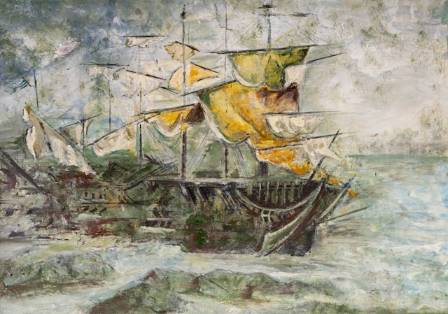
To discuss the history of human civilization is to inevitably confront the significance of ships—a symbol that transcends mere transportation. For millennia, ships have served as lifelines of global trade, facilitating economic prosperity and cultural exchange across continents; yet, they have also been instruments of colonial expansion and the transatlantic slave trade, bearing witness to humanity’s darkest atrocities. This dual nature of ships—their role as agents of connection and conflict—has made them enduring subjects in the world of art. Nautical paintings, or ship paintings, do more than depict the majestic beauty of vessels on the water; they capture the spirit of their eras, preserving stories of exploration, war, survival, and hope. In this expanded exploration, we will delve into the rich history of marine art, examine ten of the most famous ship paintings that have shaped the genre, and unpack the profound symbolic meanings that ships carry in artistic representation. Whether you are an art enthusiast, a history buff, or simply drawn to the allure of the sea, these works offer a window into the complex relationship between humanity and the ocean.
A Historical Overview of Marine Art: From Ancient Origins to Modern Mastery
The roots of marine art, also known as nautical art or ship painting, stretch back at least 8,000 years, making it one of the oldest artistic genres. Early examples include rock carvings of boats and navigational scenes found in coastal communities around the world, created not for aesthetic pleasure but to document daily life and spiritual beliefs. As civilizations advanced, marine art evolved from functional documentation to a respected artistic form, with its golden age unfolding between the 16th and 19th centuries in Europe and later in America. During this period, maritime paintings were deeply influenced by European colonial ambitions and naval power struggles, with wealthy patrons, religious institutions, and governments commissioning works that celebrated naval victories, commemorated trade expeditions, or depicted mythological sea scenes. A defining feature of classical marine art is its focus on detail—artists meticulously rendered ship rigging, hull designs, and sea conditions, while also using light and color to capture the ocean’s ever-changing moods, from serene sunlit waters to tempestuous storms. One of the pivotal figures in shaping the genre was the Dutch artist Hendrick Vroom, who revolutionized marine painting in the late 16th and early 17th centuries by creating dynamic, large-scale depictions of Dutch and English naval battles. His work not only popularized the genre in the Netherlands but also inspired a generation of British maritime artists, solidifying marine art as a powerful medium for political and cultural expression. By the 19th century, the genre expanded to include more personal, emotive works, with artists like J.M.W. Turner using ships as a vehicle to explore themes of nature’s power and human vulnerability.
Top 10 Famous Ship Paintings: Masterpieces of the Maritime Genre
1. The Storm on the Sea of Galilee (1633) by Rembrandt van Rijn
No discussion of famous ship paintings is complete without Rembrandt van Rijn’s The Storm on the Sea of Galilee, a work that holds both artistic and historical significance. Painted in 1633, shortly after Rembrandt moved to Amsterdam, this oil-on-canvas masterpiece is the Dutch master’s only known seascape—a fact that adds to its allure and rarity. The painting depicts a biblical scene from the Gospel of Mark, where Jesus calms a violent storm that threatens to capsize the boat carrying his disciples. Rembrandt used this religious subject to showcase his technical prowess and artistic maturity, employing dramatic lighting (chiaroscuro) to emphasize the contrast between the chaos of the storm and the serenity of Jesus. Tragically, the painting was stolen in 1990 from the Isabella Stewart Gardner Museum in Boston and remains missing to this day, making it one of the most infamous art heists in history. Its disappearance has only heightened its reputation as a iconic work of nautical art, a testament to Rembrandt’s ability to capture both human emotion and the awe-inspiring power of the sea.
2. Seascape in the Morning (c. 1640–1645) by Simon de Vlieger
Simon de Vlieger, a Dutch painter and tapestry designer, specialized in serene, atmospheric landscapes and beach scenes, and his Seascape in the Morning is a quintessential example of his style. Created between 1640 and 1645, this oil-on-panel work depicts a quiet morning scene where fishermen prepare to return to sea, their small boats anchored near the shore. The painting is characterized by its soft, golden light, which bathes the water and the distant ships, creating a sense of tranquility and calm. A wisp of smoke rising from the right side of the composition suggests that the fishermen camped on the shore overnight, adding a touch of human warmth to the natural landscape. De Vlieger’s attention to detail is evident in the subtle rendering of the water’s surface, which reflects the sky’s gentle hues, and the delicate lines of the ships’ rigging. Currently housed in the National Gallery of Art in Washington D.C., this work offers a peaceful counterpoint to the dramatic storm scenes that dominate much of marine art, highlighting the ocean’s role as a source of livelihood rather than danger.
3. The Trojan Women Setting Fire to Their Fleet (c. 1643) by Claude Lorrain
French Baroque artist Claude Lorrain (born Claude Gellée) was a pioneer of landscape painting, and hisThe Trojan Women Setting Fire to Their Fleet is a masterpiece that blends classical mythology with nautical imagery. Painted around 1643, this oil-on-canvas work depicts a scene from Virgil’s Aeneid: after the fall of Troy, the Trojan women, weary of wandering and unwilling to continue their journey to Italy, set fire to their ships to force their companions to settle. Lorrain approached the subject with classical rigor, using his signature luminescent sky to create a dramatic backdrop—dark clouds gather in the distance, signaling an impending storm sent by Jupiter to extinguish the flames. The artist’s attention to detail is remarkable, from the intricate rendering of the ships’ hulls to the emotional expressions of the women. Commissioned by Cardinal Girolamo Farnese, a key figure in the fight against Calvinism, the painting also carries subtle political undertones, reflecting the tensions of the era. Today, it is housed in the Metropolitan Museum of Art in New York, a testament to Lorrain’s ability to merge narrative, landscape, and nautical art into a cohesive and powerful work.
4. Battle of Trafalgar (1805) by Louis Philippe Crépin
Louis Philippe Crépin’s Battle of Trafalgar is a stirring tribute to one of the most famous naval battles in history. Painted in 1805, the same year the battle took place, this oil-on-canvas work depicts the clash between the British Royal Navy and the combined French and Spanish fleets during the Napoleonic Wars. Crépin, a French artist who specialized in maritime paintings, was later awarded the honorary title of Peintres de la Marine (Painter of the Navy) in 1830, a distinction bestowed on artists dedicated to capturing naval life and battles. What makes this painting unique is its contrasting tone: the scene appears almost still, as if frozen in time, yet the distant bursts of smoke and the positioning of the ships convey the intensity of the conflict. The foggy atmosphere adds a sense of mystery, leaving viewers to wonder about the outcome of the battle (the British ultimately won, securing their naval dominance for decades). Though the painting’s current location and exact dimensions are unavailable, it remains an important example of how ship paintings were used to document and commemorate historical events.
5. A First-Rate Man-of-War Driven Onto a Reef of Rocks, Floundering in a Gale (1826) by George Philip Reinagle
George Philip Reinagle’s A First-Rate Man-of-War Driven Onto a Reef of Rocks, Floundering in a Gale is a dramatic depiction of nature’s power over human technology. Painted in 1826, this oil-on-canvas work shows a large British warship being tossed onto a rocky reef by a ferocious storm, its sails torn and its hull at risk of breaking apart. The British flag at the top of the ship struggles to remain visible through the chaos, a poignant symbol of national pride under threat. Reinagle used bold brushstrokes and a dark, moody color palette to emphasize the violence of the storm, with sunlight breaking through gray clouds to highlight the ship’s vulnerability. Notably, there are no visible human figures in the painting, yet the sense of despair is palpable—viewers can easily imagine the terror of the crew as they face impending doom. Currently housed in the Royal Albert Memorial Museum & Art Gallery in Exeter, England, this work is a classic example of the “storm at sea” subgenre, which explores humanity’s fraught relationship with the ocean.
6. The Slave Ship (1840) by J.M.W. Turner
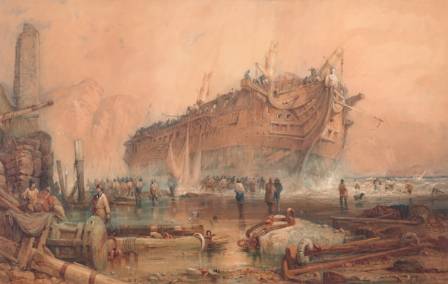
J.M.W. Turner, one of the greatest Romantic painters, used his work to challenge viewers’ perceptions of the sea and its role in history, and The Slave Ship (officially titled Slavers Throwing Overboard the Dead and Dying, Typhoon Coming On) is his most powerful and controversial nautical painting. Created in 1840, this oil-on-canvas work was inspired by the Zong massacre of 1781, where the crew of a slave ship threw over 130 enslaved Africans overboard to claim insurance money for “lost cargo.” Unlike Turner’s more romantic depictions of the sea, this work is dark and visceral, using a chaotic mix of cool and warm tones to convey the horror of the event. A mangled ankle, presumably of an enslaved person, is visible in the foreground, a stark reminder of the human cost of the slave trade. When the painting was first exhibited at the Royal Academy of Arts, it sparked outrage and debate, forcing viewers to confront the atrocities of colonialism. Today, it is housed in the Museum of Fine Arts in Boston, a testament to Turner’s ability to use art as a tool for social commentary.
7. Snow Storm; Steam-Boat off a Harbour’s Mouth (1842) by J.M.W. Turner
Two years after The Slave Ship, Turner created another iconic nautical work: Snow Storm; Steam-Boat off a Harbour’s Mouth. This 1842 oil-on-canvas painting depicts a steamboat caught in a brutal snowstorm, its form barely visible through the swirling snow and mist. Turner’s innovative approach to the work is striking—he abandoned precise detail in favor of a hazy, atmospheric style that mimics the disorienting conditions of the storm. The ship appears as a vague shadow at the center of the composition, emphasizing its insignificance in the face of nature’s fury. Turner later claimed that he tied himself to the mast of a ship during a storm to experience the scene firsthand, a story that underscores his dedication to capturing the raw power of the sea. Housed in Tate Britain in London, this work is a precursor to Impressionism, as Turner prioritized light and movement over realism, redefining the possibilities of marine art.
8. Lumber Schooners at Evening on Penobscot Bay (1860) by Fitz Henry Lane
Fitz Henry Lane, one of America’s most celebrated maritime painters, was known for his detailed, serene depictions of coastal life, and Lumber Schooners at Evening on Penobscot Bay is a prime example of his style. Painted in 1860, this oil-on-canvas work depicts a peaceful evening scene on Maine’s Penobscot Bay, where two lumber schooners float calmly on the water as the sun sets in a blaze of pink and orange. Lane’s use of color and light is masterful—he captures the way the sunset’s hues reflect off the water, creating a sense of warmth and tranquility. The composition is clean and balanced, with the schooners positioned to draw the viewer’s eye toward the horizon. Lane’s attention to detail is evident in the precise rendering of the ships’ rigging and the delicate clouds in the sky. Currently housed in the National Gallery of Art in Washington D.C., this work reflects the American Romantic fascination with nature and the sea, offering a glimpse into 19th-century coastal life.
9. Red Boats; Argenteuil (1875) by Claude Monet
French Impressionist leader Claude Monet brought a fresh, vibrant perspective to marine art with his work Red Boats; Argenteuil. Painted in 1875, this oil-on-canvas work depicts a sunny day on the Seine River in Argenteuil, a small town west of Paris that was a favorite destination for Impressionist artists. The painting is dominated by bright, cheerful colors: the river shimmers in shades of blue and green, while two bright red boats stand out in the foreground, their color contrasting sharply with the surrounding landscape. Monet used loose, rapid brushstrokes to capture the movement of the water and the play of light, embodying the Impressionist focus on capturing a moment in time. The scene is relaxed and idyllic, with small boats scattered across the river and a few figures enjoying the day. Housed in the Fogg Museum (part of Harvard Art Museums) in Cambridge, Massachusetts, this work is a departure from the dramatic, historical ship paintings of the past, instead celebrating the simple beauty of everyday life by the sea.
10. Fishing Boats, Key West (1903) by Winslow Homer
Winslow Homer, one of America’s greatest artists, was a master of watercolor, and Fishing Boats, Key West (1903) is a stunning example of his skill. Created with watercolor and graphite on off-white wove paper, this work depicts a group of fishing boats anchored in Key West, Florida, on a warm summer day. Homer used subtle shades of blue and green to capture the clarity of the tropical water, while his clever use of reserved white space highlights the sunlight reflecting off the waves and the boats’ hulls. The graphite lines add detail to the boats’ rigging and the fishermen’s equipment, grounding the otherwise ethereal scene. The painting evokes a sense of calm and tranquility, capturing the rhythm of coastal life. Currently housed in the Metropolitan Museum of Art in New York, this work is a testament to Homer’s ability to find beauty in ordinary moments, solidifying his reputation as one of America’s premier maritime artists.
The Symbolism of Ships in Art: Beyond the Canvas
Ships in art are more than just representations of nautical vessels—they carry deep symbolic meanings that vary depending on the context and era. At their core, ships often symbolize journey and transition, representing the passage from one place (or state of being) to another. They can also stand for safety and refuge, a haven in the midst of the ocean’s chaos, or conversely, a symbol of danger and uncertainty, as seen in storm scenes where ships are tossed by waves. In historical and political contexts, ships have been used to represent power and empire, celebrating naval dominance or colonial expansion. They also carry spiritual connotations, often symbolizing hope, destiny, or the afterlife—ancient civilizations, for example, often depicted ships as vessels carrying souls to the underworld. In more modern works, ships can symbolize nostalgia for a bygone era of sailing or the impact of industrialization (as seen in Turner’s steamboat paintings). Ultimately, the symbolism of ships in art is a reflection of humanity’s complex relationship with the sea—a force that is both life-giving and destructive, a bridge between worlds and a barrier between them.
Conclusion: The Enduring Legacy of Ship Paintings
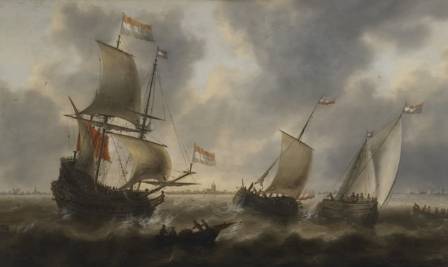
The famous ship paintings explored in this article offer more than just aesthetic pleasure—they are windows into history, capturing the triumphs and tragedies of humanity’s relationship with the sea. From Rembrandt’s biblical drama to Monet’s Impressionist idyll, these works showcase the diversity of the marine art genre, highlighting how artists have used ships to explore themes of power, survival, beauty, and injustice. They also remind us of the sea’s enduring allure—a force that has inspired artists for millennia and continues to captivate viewers today. Whether documenting historical events, celebrating coastal life, or challenging social norms, ship paintings hold a unique place in the art world, bridging the gap between past and present. For anyone who has ever looked out at the ocean and felt a sense of wonder, these works resonate deeply, reminding us of the sea’s power to shape our history and our imagination.